Rechercher dans ce blog

Tuesday, March 21, 2023

Don't let the dreaded 'Disney rash' derail your vacation: Experts ... - KSLTV

ragamnyakabar.blogspot.com

A Centers for Disease Control and Prevention report found that more than 15% of American adults are physically inactive. Additionally, according to the Mayo Clinic, they walk only 3,000 to 4,000 steps, on average, daily. That’s less than 20% of the recommended minimum amount of movement.

Between increasing remote work and a rise in jobs that require people to be in front of a computer all day, Americans have become more sedentary.

So what happens when Americans visit a Disney theme park and take 20,000 steps or more a day in hot, humid weather? Many get “Disney rash.”

If you plan on visiting Disney or any other theme park in a warm climate, here’s what you can do to prevent it and what items you should bring to treat it.

Disney rash isn’t actually a rash

It is a nickname for exercise-induced vasculitis (EIV). This condition also happens to runners, dancers, hikers, golfers, swimmers, or simply those standing for long periods in warm climates and heat.

“When the body goes through a vigorous, active period, like prolonged walking, running, or playing sports, it creates an imbalance in the normal functioning of the vascular system,” said Dr. Sony Sherpa. “This leads to swollen and weakened capillaries, which can lead to redness and discomfort.”

“These painful, red or purple splotches appear on areas of the skin not covered by clothing and last anywhere from 3-10 days,” added Catherine Burger, chief nursing officer. “It appears in people who typically are not active yet suddenly spend hours walking in hot or humid weather.”

“Although the exact cause of this condition is unknown, some scientists think that the combination of heat exposure and exercise can damage both muscle fibers and blood vessels, leading to the development of a rash,” said Dr. Kelly Johnson-Arbor, board-certified emergency medicine physician.

Fortunately, it isn’t dangerous or life-threatening and usually disappears on its own. However, it can cause an uncomfortable feeling of itchiness, stinging sensation, or even pain.

If you get the Disney rash, it will most likely stick around long enough to put a damper on your trip to the happiest place on earth.

How can you prepare for a Disney trip to prevent it?

A lack of regular exercise combined with the sheer size of theme parks and the Florida heat is a recipe for disaster. Disney’s Magic Kingdom is 142 acres, and Animal Kingdom, Disney’s largest park, is over 500 acres.

“If your body is not used to prolonged periods of walking, especially in the heat, you are more likely to end up with EIV. Start a daily walking routine a few months before your trip and slowly increase your distances to tolerance,” recommended Dr. Peter J. Scordilis, a certified chiropractic sports physician at Scordilis Health and Performance Center.

“If you live in a cold climate, it is better to perform these workouts indoors so the temperature is closer to what you will experience in Florida.

“Preparing your body, especially your blood vessels, will reduce the risk of inflammation due to overexertion. You can also perform some gentle lower body mobility exercises to prepare your ankles and calves for the increased movement,” added Scordilis.

What should I pack to help prevent Disney rash?

While the exact cause of the condition is unknown, and there is no foolproof way to prevent it, experts recommend wearing the following items to give you a leg up against the Disney rash:

  • Compression socks: Published research shows that EIV and vein challenges are connected, so wearing compression socks can help prevent lower leg and ankle swelling. Wearing them can also reduce the likelihood of the rash by improving muscle recovery time and reducing vascular swelling.
  • Longer socks: EIV generally spares covered areas of skin, so avoid low-cut ankle socks.
  • Clothing with lightweight fabric: Experts recommend wearing thin athletic-style outfits that help keep the body cool to prevent overheating.
  • Comfortable and supportive shoes: Athletic sneakers are best, not sandals, dress flats, flip-flops, or flimsy sneakers. You want to pick shoes that will reduce stress on your muscles.

What can I do during amusement park days to prevent it?

When planning theme park days, most people try to squeeze in as many Disney rides and attractions as possible. However, keeping your health in mind is essential, or EIV may bring down a much-looked-forward-to trip.

Experts recommend incorporating the following healthy habits to reduce the possibility of getting the Disney rash:

  • Take breaks: Long days of walking and standing in ride lines in the Florida humidity is not easy on your body. Therefore, incorporating five or ten minutes of sit-down breaks to rest your legs during the day is essential.
  • Elevate your legs: When sitting down for meals or small breaks, elevate your legs, especially if regular exercise is not part of your daily routine.
  • Keep hydrated: Dehydration can make a person more prone to EIV. Bring a reusable water bottle to the parks and ask for complementary water and ice throughout the day. Disney allows you to bring outside food and drink, so pack electrolyte-packed beverages like Gatorade or Vitaminwater.
  • Mind your magnesium: Magnesium deficiency is common among Americans, and there is evidence that it can make people more prone to EIV. So take a magnesium supplement each morning or pack magnesium-rich coconut water to drink throughout the day.
  • Bring a mini-first aid kit: Many parkgoers put Band-Aids in their backpack in case of blisters. Make sure to add a small tube of hydrocortisone as well as over-the-counter pain relievers.

Disneyland’s record-breaking regular shares his wisdom from nearly 3,000 park visits in a row

I’ve gotten Disney rash; What should I do?

“Cooling down properly and avoiding overexertion are key interventions,” said Sherpa. “Apply an ice pack on the affected area and elevate your feet to improve circulation.”

Even if you’re in the park and have none of the recommended items in your bag, you can still treat a Disney rash immediately.

  • If you’re far from a first-aid station, ask the nearest restaurant or refreshment stand for ice to start immediate treatment.
  • If you can continue with your park day, cover the affected area to avoid additional sun exposure and apply a wet compress to the skin throughout the day to keep it cool.
  • Once you return to your accommodations, take a cold shower or bath and continue elevating your feet and legs.

According to Viktoryia Kazlouskaya, a board-certified dermatologist, only in rare instances is the rash severe and requires further attention from a doctor.

Don’t let Disney rash derail expensive trip

A basic Disney vacation for a family of four costs over $6,000 for transportation, lodging, food, and park tickets. With some preparation, a smartly packed suitcase, and a prepared park backpack, you’ll keep yourself and your family off the sidelines and in line for all the Disney rides and attractions you’ve dreamed of experiencing.


This article was produced and syndicated by Wealth of Geeks.

Adblock test (Why?)


"avoid it" - Google News
March 21, 2023 at 08:49PM
https://ift.tt/WIc90ub

Don't let the dreaded 'Disney rash' derail your vacation: Experts ... - KSLTV
"avoid it" - Google News
https://ift.tt/qbiWrSG
https://ift.tt/L8u1s46

Monday, March 20, 2023

What Is NFT Wash Trading? How To Identify And Avoid It? - AlexaBlockchain

ragamnyakabar.blogspot.com

So, you’ve spent hours scouring the internet, looking for the perfect digital asset to add to your collection. You’ve finally found it – a rare and coveted NFT that you just have to have. You’re ready to buy it, but before you do, there’s something important you need to know about – NFT wash trading.

Non Fungible Token wash trading is a problem that’s been plaguing the crypto market, and it can have serious consequences for buyers like you.

But don’t worry – in this guide, we’ll demystify the practice and show you how to avoid it.

Ready? Let’s dive in.

What is NFT Wash Trading?

NFT wash trading is a sneaky scheme where buyers and sellers collude to artificially inflate the value of an NFT.

Here’s how it works: these individuals agree on back and forth trades for an NFT, with each trade increasing the price of the NFT. This makes it seem like there’s high demand for the NFT, but in reality, it’s just an illusion.

For example, imagine you’re interested in buying a rare NFT that’s priced at $10,000. You notice that the NFT has been traded several times in the past few minutes, with each trade increasing the price by $500.

This might make you think that there’s high demand for the digital asset and that it’s a good investment. But in reality, those trades could be part of a wash trading scheme to artificially inflate the price.

Why is Wash Trading of NFTs a Problem?

Wash trades may seem harmless at first, but it can leave serious consequences on both the market and the people involved. Here are some reasons why it is such a big problem:

1. Effects on the NFT market

This practice can cause the price of an NFT to skyrocket artificially. This can be damaging to the NFT market because it creates a false sense of demand for certain NFTs. When people start buying NFTs at inflated prices, it can lead to a bubble that eventually bursts, leaving investors with worthless assets.

Furthermore, this malicious practice can make it difficult for people to accurately assess the value of an NFT. When wash traders artificially manipulate an NFT’s value, it can be hard to tell if it’s actually worth the asking price. This can lead to people overpaying for NFTs, which is never a good thing.

2. Ethical implications

Wash trading activity goes against the spirit of the NFT market. The market is supposed to be a place where people can buy and sell unique and valuable digital assets.

When people engage in wash trading, they’re essentially cheating the system and taking advantage of others – this doesn’t leave good optics on the market.

Imagine you’re a newcomer to the NFT market, and you buy an NFT that’s been artificially inflated through wash trading. You might think that you’re getting a good deal, but in reality, you’ve been tricked into overpaying for an asset that isn’t worth as much as you thought.

This is not only unethical, but it can also discourage people from participating in the NFT market altogether.

3. Legal implications

Wash trading can have legal implications as well. In many cases, wash trading is considered a form of market manipulation, which is illegal in most jurisdictions. If you’re caught engaging in wash trading, you could face fines, legal action, or even jail time.

Furthermore, if you’re a victim of NFT wash trading, you might be able to take legal action to recover your losses. However, this can be difficult, especially if the people involved in the wash trading are anonymous or hard to track down.

4. Reputation damage

Rise in wash trading can damage the reputation of the NFT market as a whole. If people perceive the market as being filled with fraudulent and unethical practices, it can be hard to attract new investors and buyers. This can limit the growth potential of the market and hurt legitimate NFT creators and sellers.

Having said all this, let’s take things a step further.

How To Identify A Wash-Traded NFT?

Identifying NFT wash trading can be tricky. But there are some red flags to look out for to reinforce your asset security. Here are some key indicators that may suggest wash trading is happening:

1. A high trade volumes with few unique wallet address

If you notice an NFT being traded frequently, but it’s always between the same two or three wallet addresses, this could be a sign of wash trading.
Why?

Because it suggests that the trades are not genuine transactions between different buyers and sellers, but rather coordinated efforts to manipulate the price.

To identify this red flag, you can use blockchain explorers like Etherscan to track the number of transactions involving a specific NFT and the wallets involved. If you notice a pattern of high trading volume with few unique wallets, it’s a warning sign.

2. Rapid price fluctuations

Always check to see if an NFT’s price fluctuates wildly in a short period of time. This could indicate wash trading.

This is because genuine market demand doesn’t usually fluctuate that quickly. Instead, rapid price changes could indicate that buyers and sellers are trading the NFT back and forth to manipulate its perceived value.

How can you identify this red flag? Be sure to track the price of the asset over time using marketplaces or price trackers like Nansen. Here’s an instance from Dune Analytics:

NFT Trading Volume Adjusted for Wash Trading
Example of NFT Trading Volume Adjusted for Wash Trading. Source: Dune Analytics

If you notice sudden spikes or drops in price that don’t seem to align with the broader market trends, it’s a warning sign.

3. Suspicious timing of trades

Suppose you notice an NFT being traded at odd hours or in rapid succession. This could be another sign of wash trading.

Genuine transactions don’t usually happen in such an erratic pattern. Instead, coordinated trades at unusual times could indicate a coordinated effort to manipulate the NFT’s perceived value.

To identify this red flag, you can use blockchain explorers or marketplaces to track the timing of trades involving the NFT. If you notice trades happening frequently and at odd times, it’s a warning sign.

4. Inflated prices with little market history

NFTs with a high price tag but little market history can be wash-traded assets. It suggests that the NFT’s perceived value has been artificially inflated by coordinated trading, rather than genuine market demand.

If you want to find out, you can use blockchain data or price trackers to look up the NFT’s past sales history. If you see a sudden spike in price without any corresponding increase in market demand, it’s a warning sign.

5. Unusual trading patterns compared to similar NFTs

If you notice an NFT with trading patterns that are significantly different from other similar NFTs, be careful – wash trading might be going on.

Genuine market demand tends to follow similar patterns across comparable NFTs. Unusual trading patterns could indicate coordinated efforts to manipulate the price.

To identify this red flag, you can use marketplaces or price trackers to compare the trading patterns of similar NFTs. If you see an NFT with significantly different trading patterns, it’s a warning sign.

How to Protect Yourself From NFT Wash Trading?

Now, you’ve learned how to identify NFT wash trading. But don’t stop there! To truly protect yourself, you need to take proactive steps to prevent yourself from becoming a victim of this scam. Here’s how:

  • Do Your Research: Before investing in any NFT, research the seller, artist, and other buyers. Check out their social media profiles, websites, and other online presence to see if they have a history of NFT wash trading or other fraudulent activities.
  • Use Reputable Marketplaces: Only use reputable trading platforms that have a history of authentic transactions. Avoid buying from small or unknown platforms that lack credibility.
  • Pay Attention to Transaction History: Look at the transaction history of the NFT you’re interested in. If you notice a high volume of trades within a short period, remember that’s a red flag for wash sales. So, steer clear.
  • Be Wary of Low Prices: If an NFT is priced significantly lower than its market value, it could be a sign of NFT wash trading. The seller could be artificially inflating the price to attract buyers and then buying it back from themselves.
  • Stay Away from Unusually High Trading Volumes: If an NFT has an unusually high trading volume, it’s a sign that something might be off. Be wary of high trading volumes, especially if they are from one or two traders.
  • Use Tracking Tools: There are many tracking tools available that allow you to monitor the transactions of an NFT. Use them to keep track of the transaction history and detect any suspicious activity.
  • Ask Questions: Don’t be afraid to ask questions. If something seems off, ask the seller or marketplace for more information. If they are hesitant or unwilling to provide more information, it could be a sign that something is not right.

Following these tips, you can be sure that your investments and assets are safe.

Closing Remarks

NFT wash trading is a deceptive practice that has the potential to harm unsuspecting investors. However, with the right knowledge and tools, you can protect yourself from falling victim to this scam. By identifying the red flags, doing your research, and taking proactive steps to prevent yourself from becoming a victim, you can confidently invest in NFTs without fear of NFT wash trading.

It’s essential to be vigilant and stay up-to-date with the latest information and trends in the NFT market. The world of NFTs is evolving rapidly, and scammers are becoming more sophisticated in their techniques. But by following the strategies outlined in this article, you can stay ahead of the game and make informed investment decisions.

Read Also: Yuga Labs’ TwelveFold Bitcoin NFT Collection Auction Nets $16.5M

Adblock test (Why?)


"avoid it" - Google News
March 19, 2023 at 08:37PM
https://ift.tt/L5WhOep

What Is NFT Wash Trading? How To Identify And Avoid It? - AlexaBlockchain
"avoid it" - Google News
https://ift.tt/HtlVk2q
https://ift.tt/EFD4jTk

Sunday, March 19, 2023

What Is Check Washing Fraud? How Do You Avoid It? - MUO - MakeUseOf

ragamnyakabar.blogspot.com

[unable to retrieve full-text content]

What Is Check Washing Fraud? How Do You Avoid It?  MUO - MakeUseOf

"avoid it" - Google News
March 19, 2023 at 08:00PM
https://ift.tt/P4gH6V1

What Is Check Washing Fraud? How Do You Avoid It? - MUO - MakeUseOf
"avoid it" - Google News
https://ift.tt/XCmdLpN
https://ift.tt/vWw6rap

Thursday, March 16, 2023

Silicon Valley Bank Collapses – Here's How We Knew to Avoid It - InvestorPlace

ragamnyakabar.blogspot.com

There’s a funny saying about the Federal Reserve: It keeps raising rates… until it breaks something.

Well, it looks like this time around, that “something” was Silicon Valley Bank.

Silicon Valley Bank, a holding of SVB Financial Group (NASDAQ:SIVB) went from being the 16th-biggest bank in the U.S., with about $209 billion in total assets, to nothing in less than a week.

So, what exactly happened to Silicon Valley Bank?

That’s the question I’ll answer for you in today’s Market 360 article. We’ll also review the impact Silicon Valley Bank’s collapse had on First Republic Bank (NYSE:FRC), and I’ll explain how we knew to avoid both banks well before their falls.

Plus, I’ll share where you should consider investing your money instead.

Let’s dive in.

What Happened with Silicon Valley Bank

Last week, Silicon Valley Bank proposed a $2.25 billion secondary offering to shore up a significant loss in its portfolio. However, this triggered a run on the bank’s assets after Peter Thiel’s Founders Fund advised startups to withdraw their money.

To make matters worse, out of Silicon Valley Bank’s $173.2 billion in deposits, only $21.7 billion was insured. So, there was also a real risk that the companies with uninsured deposits might not get their money back.

Investors panicked and SIVB shares plunged more than 60% on Thursday and then another 60% in pre-market trading on Friday. Trading was halted on Friday, and banking regulators stepped in and took over SVB Financial.

The Federal Deposit Insurance Corp. (FDIC) will retain all of the deposits in SVB, and it is expected to merge the bank with a larger financial institution. This will ensure that all depositors are protected, regardless of FDIC insurance limits.

Following Silicon Valley Bank’s downfall, I know there are some fears circulating that it could be the next Lehman Brothers, as it is the second-largest bank to collapse since Washington Mutual went under back in 2008.

High Interest Rates Hurt the Bank

If this is something you’re worried about, let me assure you that’s not true.

The reality is Silicon Valley Bank’s troubles were tied to rising interest rates. Thanks to startups and technology companies depositing millions of dollars into the bank, its total deposits rose to approximately $175.4 billion by December 2022. To take advantage of the deposits, Silicon Valley Bank invested $80 billion into mortgage-backed securities at about a 1.5% interest rate.

But when the Federal Reserve began to aggressively hike key interest rates last year and bond yields climbed higher – values dropped and SVB Financial found itself with a big capital problem on its hands.

I should also add that the yield curve has been inverted since July, as the two-year Treasury yield is above the 10-year Treasury yield. (As of this morning, the two-year Treasury yield stood at 4.03% and the 10-year Treasury was holding at 3.6%.) An inverted yield curve is lethal to banks, as it hurts their profitability. So, it’s no surprise that Silicon Valley Bank ran into problems.

The next big bank to fall was First Republic Bank, which just received $70 billion in emergency liquidity from the Fed and J.P. Morgan. Here in Palm Beach, near where I’m at in Florida, there is a run on First Republic’s deposits, and some folks are incurring early withdrawal penalties on certificates of deposit (CDs).

Naturally, the folks in Palm Beach are skittish after the Bernie Madoff disaster as well. Many lost money in leverage municipal bond products sold by Citibank and other financial institutions back in 2008. As long as the yield curve remains inverted, there is a risk of a contagion that other banks may fail the Fed’s capital requirements. The good news is the Fed has opened their discount window for a year (up from 90 days) to any troubled banks.

A joint statement by the Treasury Department, the Federal Reserve and the FDIC said they are taking actions that “fully protects all dispositors” in Silicon Valley Bank. That, as we’ve seen so far this week, has helped to calm financial markets.

Now, one thing I find interesting about Silicon Valley Bank is that many folks considered it a good buy before the collapse. In fact, just last month CNBC’s Jim Cramer was hyping up the stock…

“This company [Silicon Valley Bank] is a merchant bank with a deposit base that Wall Street has mistakenly been concerned by,” Mr. Cramer said. He also noted that Silicon Valley Bank was “less dependent upon private equity and venture capital offerings.” Mr. Cramer believed the stock was “cheap” and stated that “you could argue that SVB 40% up is barely a drop in the bucket.”

Yikes!

Wall Street Is Right to Be Concerned

The fact of the matter is Wall Street had every right to be concerned because Silicon Valley Bank’s fundamentals were terrible. Looking back at just the last four quarters, earnings had declined steadily – from $7.92 per share in the first quarter of 2022 to $4.62 per share in the fourth quarter of 2022. For the first quarter of 2023, earnings were expected to fall further to $4.50 per share. Revenue was anticipated to drop 12.5% year-over-year to $1.4 billion, down from $1.6 billion in the year prior.

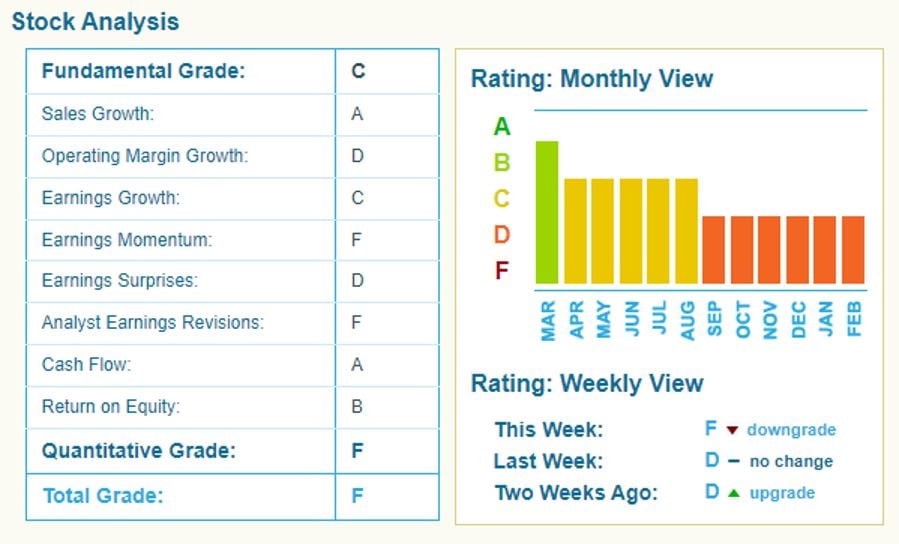
Those who took Mr. Cramer’s advice and bought Silicon Valley Bank were hit hard, but those who followed my Portfolio Grader would’ve known to stay far away from SIVB. The stock hasn’t been considered a “Buy” since March 2022, and it has been stuck at a D-rating since last September, making it a “Sell.” Following last week’s drama, Portfolio Grader revised it lower to an F-rating.

Portfolio Grader report card of Silicon Valley Bank.

Institutional buying pressure had also dried up, as evidenced by the stock’s F-rating for its Quantitative Grade.

I should add that First Republic Bank doesn’t fare well in Portfolio Grader either. It’s held a D-rating since last August. So, again, folks following my Portfolio Grader would’ve avoided the 60%+ hit the stock took on Monday, as well as its 33% fall last week.

The truth is that, at the end of the day, fundamentals matter. The market has narrowed, and we remain in a 15% market, where only the top 15% of the stocks in my Portfolio Grader have emerged as market leaders. Even before Silicon Valley Bank’s collapse, its fundamentals were not cutting it.

So, I encourage you to stick with companies that boast strong earnings and sales growth. If you’re not sure where to look, then give my Growth Investor service a try. My Growth Investor stocks are characterized by 38.9% average annual sales growth and 283.8% average annual earnings growth.

Plus, my Buy List stocks are only trading at 7.6X median trailing earnings, and the average dividend yield is 3.93%. So, low price-to-earnings ratios and strong dividend growth coupled with positive sales and earnings should support my stocks in the upcoming months.

Click here to become a member of Growth Investor today and receive full access to my Buy List stocks.

Regards,

Louis Navellier's signature

Editor, Market 360

P.S. I recently posted a message meant just for people who visit my website. It has to do with a disturbing new government program that could send an earthquake through the country’s entire financial system. My message reveals the immediate steps you need to take.

So, if you’re concerned about what’s happening to this country, you’re going to want to see what I have to say. (My message is available here for a limited time.)

Within the first 30-45 seconds, you’ll see revelations that will change everything about America.

I can’t promise that viewing this will be easy, but it could help you stay safe.

Click here right now to discover my new prediction.

Adblock test (Why?)


"avoid it" - Google News
March 16, 2023 at 11:54PM
https://ift.tt/2Txh0Y1

Silicon Valley Bank Collapses – Here's How We Knew to Avoid It - InvestorPlace
"avoid it" - Google News
https://ift.tt/IwyeLmN
https://ift.tt/aknq1QY

We all make this bathroom mistake - here's how to avoid it - The Jerusalem Post

ragamnyakabar.blogspot.com

One scientist revealed the mistake we make when we flush the toilet and the problems it causes. She claimed that one common method of lowering the water in the toilet will prevent the spread of millions of dangerous bacteria throughout the house.

Emma Harding, a molecular virology researcher and PhD candidate at Australia's University of New South Wales, explained that there are certain spots in the bathroom that we should clean more often. Even before you prepare the scotch tape and the cleaning agent, there is another way you can help prevent the spread of bacteria - and it's all related to the above mistake.

Harding claimed that one second before you flush the toilet after defecating, you must lower the lid.

"Particles of fecal residue, many bacteria and more, can escape from the toilet and spread in other places around your house. You don't need to be a great expert to know what this can cause. I recommend closing the toilet every time you flush the water," she said.

How can you protect the rest of your home?

Unfortunately, there is no method that is fast and efficient enough for fully sanitizing the bathroom.

In fact, the entire area around the toilet is completely contaminated. The ceramic behind the toilet contains millions of bacteria on its surface, the trash can, the sink and the floor. Imagine that you turn off the water when the toilet lid is lifted and the bacteria fly everywhere and even stick to your clothes with which you continue to walk around the rest of the house. Not nice.

Well, all you have to do is keep the toilet covered when you flush and try to clean the bathroom more often. "Even once a week is good," concluded Harding.

Adblock test (Why?)


"avoid it" - Google News
March 17, 2023 at 10:50AM
https://ift.tt/6cNFq0b

We all make this bathroom mistake - here's how to avoid it - The Jerusalem Post
"avoid it" - Google News
https://ift.tt/IwyeLmN
https://ift.tt/aknq1QY

Wednesday, March 15, 2023

‘Avoid’ lobster from Maine? California aquarium’s warning has lobstermen fighting back - Sacramento Bee

ragamnyakabar.blogspot.com

[unable to retrieve full-text content]

‘Avoid’ lobster from Maine? California aquarium’s warning has lobstermen fighting back  Sacramento Bee

"avoid it" - Google News
March 15, 2023 at 11:47PM
https://ift.tt/7EeXfsm

‘Avoid’ lobster from Maine? California aquarium’s warning has lobstermen fighting back - Sacramento Bee
"avoid it" - Google News
https://ift.tt/kWtziEj
https://ift.tt/Ocv6WYb

Potholes cause widespread car damage in Southern California as more than 30 vehicles disabled on 71 Freeway in Pomona - KABC-TV

ragamnyakabar.blogspot.com

POMONA, Calif. (KABC) -- More than 30 vehicles were disabled with flat tires and other damage after driving over large potholes on the rain-soaked 71 Freeway on Wednesday morning in Pomona, authorities said, as potholes caused devastating car damage all across Southern California.

The incident forced the closure of all northbound lanes on the freeway, between Rio Rancho Road and Mission Boulevard, shortly after 5 a.m., according to a California Highway Patrol incident log. No crashes or injuries were reported. It is unclear when lanes will reopen.

Traffic on the northbound 71 Freeway was backed up for miles as the morning commute got underway. More than two dozen damaged vehicles pulled over to the shoulder of the freeway.

One driver, Huynh Vu, said he was driving to work like he does every morning when his car was damaged by the potholes.

"I just saw cars that were bouncing, hitting the pothole. So I couldn't really avoid it," said Vu. "It feels like you're going off roading."

Vu said he drives on the 71 Freeway every morning, and that he had to wait more than five hours Wednesday morning for a tow truck after his car suffered major damage to the front and rear.

"I don't know if this really can be avoided so just be careful. Just drive slow," said Vu.

Caltrans says it is working around-the-clock to fix the potholes, which it blames on the recent rain impacting Southern California.

"The rain is causing the potholes," said CHP Officer Joseph Davila. "Along with all the traffic that goes through the area. Caltrans is continuously trying to repair the potholes."

Officials from Caltrans also said that they will cover car damage from potholes up to $10,000, but you will have to prove that it was the pothole that caused the damage.

Elsewhere, on the 210 Freeway westbound toward Rosemead, another pothole tore through drivers' tires, causing cars to pull over and wait for a tow truck to take them to the repair shop.

"It was just like a big hole, but it was crazy," said Taylor, a driver whose car was damaged after running over a pothole. "I've been stuck here for an hour already."

The 71 Freeway closure occurred while a flood watch was in effect for parts of Los Angeles County including the San Gabriel Valley, Santa Clarita Valley, Malibu coast and county beaches, downtown L.A., San Fernando Valley and San Gabriel mountains.

Heavy rain and excessive runoff may result in dangerous flooding of rivers, creeks, streams and flood-prone locations, the National Weather Service said.

Dry weather is expected to return Wednesday night through at least Friday, with a chance of light precipitation over the weekend.

Adblock test (Why?)


"avoid it" - Google News
March 16, 2023 at 04:45AM
https://ift.tt/4jB6DSK

Potholes cause widespread car damage in Southern California as more than 30 vehicles disabled on 71 Freeway in Pomona - KABC-TV
"avoid it" - Google News
https://ift.tt/kWtziEj
https://ift.tt/Ocv6WYb

Search

Featured Post

This North Texas city has asked large trucks to avoid its quaint downtown. They come anyway - Yahoo News

ragamnyakabar.blogspot.com Glen Rose’s downtown — lined with boutiques, antique shops, bookstores and cafes in early 20th century building...

Postingan Populer