Shocking video has emerged of SEAL recruits being tear-gassed while forced to sing “Happy Birthday” to prevent them from holding their breath.
The clip obtained by CBS News shows the Navy’s would-be warriors screaming in agony while being subjected to the choking gas for over a minute on California’s San Clemente Island.
The admiral in charge of the Sea, Air and Land special ops force has ordered an investigation into the disturbing video, which was obtained by Matthew Cole, author of “Code Over Country,” a book about SEAL Team Six.
“I got this video from some SEAL students who are trying to become SEALs and felt that the instructors and the SEALs were abusive and very careless with their health,” Cole told the news outlet.
The use of tear gas on recruits is standard across the military, though they are normally ordered to remove their gas masks briefly to experience the effects of the irritant.
During the notoriously difficult Basic Underwater Demolition/SEAL (BUD/S) training, instructors must remain at least six feet away from the recruits to avoid the danger of burns and may use the gas for no more than 15 seconds, according to CBS News.
A video has emerged of Navy SEAL recruits being tear-gassed during training on San Clemente Island in California.CBS News
The SEALs commander told CBS News that the footage raises questions about “the lawfulness of the behavior.”
The probe is looking at whether the instructors were unaware of the proper procedures or whether they meant to abuse the young men, the outlet said.
“I think this type of training is really senseless,” Sven Jordt, a Duke University associate professor who studies tear gas and its effects, told CBS News. “It looks more like a form of hazing.”
The recruits were forced to sing “Happy Birthday” while being gassed to prevent them from holding their breath during the exercise.CBS News
If approved, SEAL candidates for the first time would be required to undergo blood tests to detect the presence of a broad range of performance-enhancing drugs, including those that cannot be detected in standard urine tests.
On Feb. 4, Mullen, of Manalapan, was nearing the final days of “Hell Week,” during phase-one training at Naval Amphibious Base Coronado, near San Diego, when he died.
The shocking video comes nearly a year after New Jersey man Kyle Mullen passed away during Navy SEAL “Hell Week.”Regina MullenMullen’s mother, Regina, blamed her son’s death on the brutal training.Photo by Rachel Wisniewski for the New York Post
The official cause of death was reportedly bacterial pneumonia, which his mother, Regina Mullen, 57, attributed to the time he spent submerged in frigid water.
Regina told the New York Times — which first reported about the broad investigation into BUD/S training — that her son started taking the erectile dysfunction drug Viagra on the advice of other candidates as a possible treatment for swimming-induced pulmonary edema, or SIPE.
"seal" - Google News
October 06, 2022 at 01:17AM
https://ift.tt/X29pUL3
Navy SEAL recruits forced to sing 'Happy Birthday' while being tear-gassed - New York Post
"seal" - Google News
https://ift.tt/aUMxdpB
https://ift.tt/QtmVbH6
There comes a time when one feels the symptoms of burnout, but knowing how to handle it will make life easier to live.
Actress-vlogger Rica Peralejo shared her sure-fire ways on how to deal with this kind of stressful situation.
Peralejo drove home her point about burnout in an Instagram post on Wednesday, wherein she shared a short video of her doing many things like eating, exercising, cooking with snippets of Beyoncé’s Commencement Speech for the class of 2020 in the background, with the theme about “embracing the struggle.”
“Don’t talk about what you’re gonna do. Don’t just dream about what you’re wanna do. Don’t criticize somebody else for what they’re not doing. You, be it, be about it. Be about that action and go do it. Keep an eye on your intention. Don’t let any outside distraction or your own insecurity stop you from your goals. Embrace that struggle. Surviving that struggle will strengthen you,” Beyoncé’s resonant voice chimed in the background.
Peralejo shared: “So easy to give up where you aren’t naturally gifted in. But sometimes, some causes, need you to get out of the comfort zone. Not all do, but those that will and should, you must get up for and work hard for,” she said.
She offered that what keep her from burning out is knowing that the challenges were truly worth it, like the love of family, telling stories for God, of healing, and freedom of people.
“I realized you only really, truly burn out when you are working hard for something that asks for more than it ought to, and you are giving it more than you ought to. Only a few things in life require our entirety,” she said.
She then advised that “in a world of competing ideologies and advanced capitalistic forms, DO NOT BE AFRAID TO BE SMALL IF THAT IS WHAT GOD IS CALLING YOU TO DO.”
Going way too big always has its costs, she said. Thus “weight matters.”
“Every delivery asks if I am going beyond a kilogram and every pound added tips the scale, so let us be sure of the things we OUGHT TO CARRY, for only then can we bear the burden!” she said. EDV
Neil Brown Jr. grew up idolizing his father, a Vietnam-era Marine.
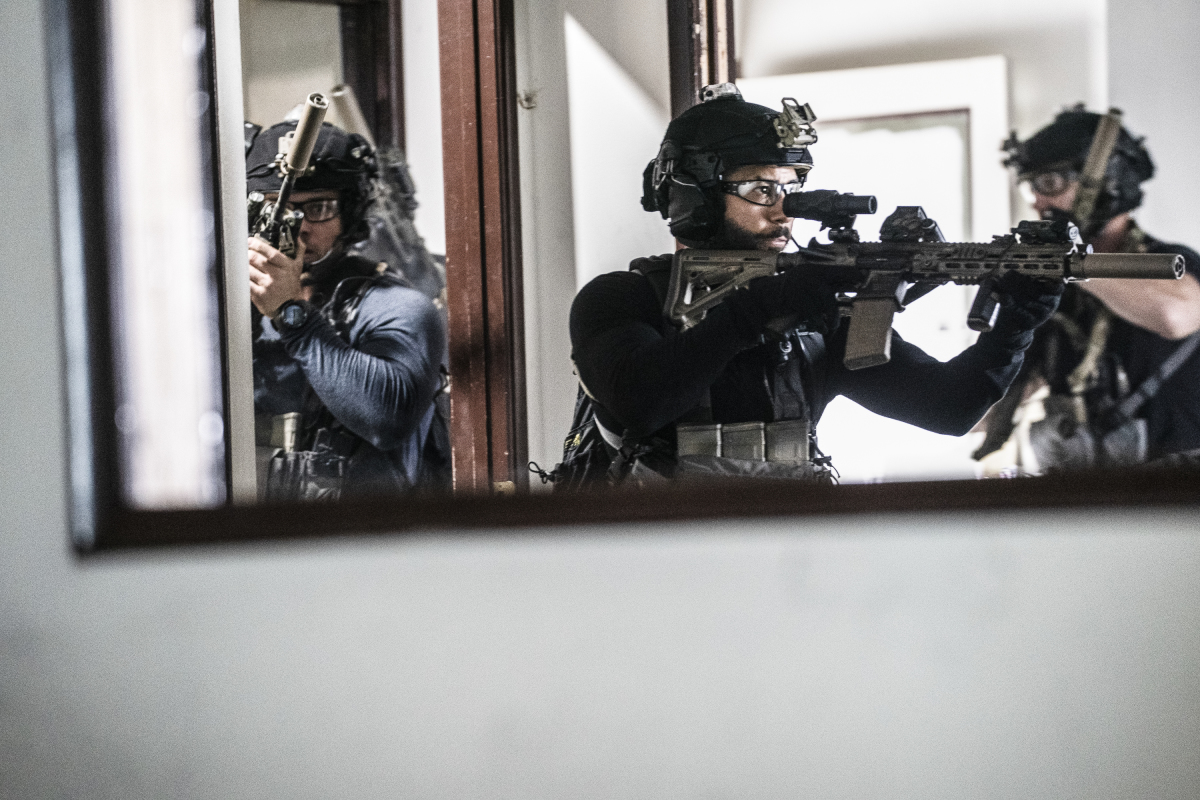
At one point, that admiration was so strong that he’d set his sights on a career in the military after school. But life had other ideas, diverting him into the world of entertainment. Still, Brown Jr. was able to honor his roots through the acting opportunities that rolled his way, appearing in the action film Battle: Los Angeles and the war drama Sand Castle. Following a number of great supporting performances, the role of his career arrived in the form of Navy SEAL Ray Perry, whom he plays in the Paramount+ series SEAL Team.
We spoke with Brown Jr. about the unique challenges of portraying a special forces operator, the gym sessions that get him action-ready and what it’s like to film those iconic battle scenes.
Before you became an actor you wanted to join the military, correct?
My father always credited the military for making him the man that he is, so it only made sense that I wanted to go in that direction too. I ended up in the Air Force Junior ROTC, and had a lot of friends who were in the Sea Cadets. Those programs helped build a great foundation for me in my youth. I cared how my uniform looked. My creases could cut cheese and you could see yourself in my shoes. I loved everything about being a part of a team like that.
Even in college my sights were set on joining up in the US army, going to 1st Ranger Battalion, and eventually making it into Special Forces Operational Detachment-Delta. I was so devoted to it that I even got my wife, who was my girlfriend at the time, to look into a career in the military. But our plans changed after my wife got pregnant. My dad personally didn’t ever want me in a uniform, and he didn’t want me in the military. That didn’t stop me from wanting to be just like my dad, and I still want that. I am lucky that I get to do that in some form with the series and by playing Ray Perry.
What’s it been like portraying an operator in the Navy SEALs?
I’m not going to lie, I enjoy getting to jump out of planes for work, and I like blowing stuff up like any guy would. There is heart in all of these roles of course, but there is also the badass action. I’m still a kid in my soul. I have to admit these shows have helped me become a better man. I’m proud to represent the best of us in many ways, and showing that courage is doing what you need to do in spite of fear, not in the absence of it. I love going into experiences that I can learn during, and that is what this show has been: an opportunity to learn.
How do you go about learning everything that you need for the authenticity of the show?
There is plenty of on the job training on SEAL Team. The beauty of our production is that there are tons of special operators around at all time. They are ingrained in the show from top to bottom. They’re in the writers room, on set, and working as tech advisors throughout. There are even veterans acting on the show, like Tyler Grey and Scott Foxx. Then there are other actors in the background, like Remi Adeleke, who I also used as a resource when getting ready for Ray. So if I have any questions, all I have to do is look to my left or right and ask someone.
How realistic is the gear that you’re wearing and carrying around?
On set pretty much everything that we have on and that gear that we are carrying is real. The only thing that we really swap out are the plates in our vest carriers. On occasion the NODS, aka the night vision, that we’re wearing might not be real. But really the majority of it is. There is somewhere between 30 to 40 pounds of gear on your person at all times and it takes a little while to learn how to maneuver with everything. I will say it’s the best way to learn, diving in like that, and it didn’t take long between we were moving pretty well as a squad.
SEAL Team is a pretty physical show — did you and the rest of the cast go through any kind of boot camp to prepare?
I will say that everyone in the cast was already pretty in shape when we arrived. There was a small course we went through to fine tune how we were using the weapons and put on the gear. For the gym sessions, I have been working out in some form or fashion since I was four years old. Not just in the gym — I’ve trained in boxing, Muay Thai, Shotokan karate, and many others. I’ve gotten a belt or dabbled in almost every marital art there is.
I started lifting weights young, probably a little too young, but hey, lifting is life. The thing about lifting, especially when you are doing it young, is your body adapts to it very quickly. Getting ready for this show changed my life in a lot of ways; I discovered a heart condition that I wasn’t aware of before. That forced me to find new ways to train, instead of just lifting massively heavy weights for low rep counts. I quit caffeine, and had to learn how to train intensely with no pre-workout. But I love bodybuilding and I found a way to push my limits despite that.
How did you take your training to the next level for the latest seasons of SEAL Team?
I first discovered Y3T from Neil Hill online, while looking for new ways to break my body. I’ve always been a fan of bodybuilding. I looked up to bodybuilders growing up and wanted to be the Incredible Hulk. I was a big comic book nerd. I saw out how brutal the programming was with the rep range and I was blown away. I started to do every program of his that I could find online and they were wrecking me. I can now attest that they are just a taste of what he’s able to do in the lab.
Thanks to the success of the show I was able to actually connect with Neil Hill on social media, and we started working together over the phone. The sessions he had me do were insane, but I was quickly seeing a change in my body composition. Before working with him I thought 10 was a high rep count, but now I’m doing “century” — 100 with considerable weight. I used to do progressive resistance and pyramid up in reps. But Neil is a little more diabolical and he’ll have me pyramid down. That’s starting with the heaviest weight that you can handle. That sucks.
I keep my body at about 20 pounds below what it wants to be, in order to look lean and move around with some agility. I’m over 40 and in the best of shape of my life now because of SEAL Team.
What does your home gym situation look like?
We used to have a pretty sick gym situation on set, but sadly that had to go away. On the bright side I was able to focus on finishing up my setup at home, which I have called endearingly started to call the “Pain Palace.” The squat rack and bench were the first things that I just had to have. Neil told me that we had to have legs. Now I work legs more than anything, which has worked out great, because my wife loves my thighs. The best part of having a home gym is that I can train anytime of the day, which is good because there are quite a few times when I’m not done filming until two in the morning. And that’s when I’m going to get a lift in.
SEAL Team has a good number of large scale action sequences, and there was an especially big one at the start of this season. What is it like doing those with the whole Bravo 2 crew, especially David Boreanaz, who plays Jason?
Those scenes are a lot of fun, because they’re so big and there’s so much going on between the squad. We’re playing off of each other from different locations. David might be 100 or 200 yards away from me, doing his own work on the ground. They’ll yell action for each of us to do our thing in that moment. Meanwhile there are explosions are going off, and even if they aren’t real, they feel real. Gunfire is going off everywhere. It’s hard not to feel genuine emotions amidst that chaos, while you’re trying to focus on your acting, of course.
There are so many things to coordinate while these explosions are going off, and the team has become very good at noticing when something’s off. We have the best stunt guys and armorers around. Everybody knows where everyone else is going, at what pace, and where their weapons should be pointed. Every element is actually happening, which is maybe why it can feel so hectic and chaotic, and I think that’s what makes those action scenes hit so well. Filming can feel like a blur sometimes, and on occasion I’ll see the show pop up on the television and can’t believe how cool some of the sequences look.
Do you have any scenes that have been especially physical for you?
We get pretty smashed on the cardio front. Ray’s on the sniper rifle, which means I have to be on the move a lot, hiking around. David [Boreanaz] has enjoyed punishing the cast on the occasions where he’s in the director’s chair, I’ve noticed. He’s my brother…but damn. If he finds a random hill that looks badass to run up, he’s going to make us all run up it. I remember David was trying to get something extra out of me, and it was starting to get to me. I wanted to take the stock of my gun and smack it in his face. I know he felt it too, because he ran up to me and told me to give him a hug.
The kidnapping storyline that Ray went through was uniquely draining. The experience was completely exhausting, both mentally and physically. I felt like I was not doing the scenes justice if I wasn’t going to a place that took something out of me. There’s a moment where they’re putting a drill through Ray’s leg; I had a lot of people tell me that that scene affected them. It was also rough being away from my castmates, doing that kind of material on my own.
The team is sporting a couple great beards.
I had one from the very beginning. I’d just finished up on a movie called City of Lies with Johnny Depp and I’d grown my beard out for the role. I remember getting told about the pilot for this series, which was called the SEAL Show at the time. One of the first scenes was between me and Max Thieriot’s character Clay. My agents were telling me that I should shave off my beard before I went in, but I kept it. I wanted to go in there bearded up and ready to roll. It was probably the first time that I have shown up to audition not clean-shaven. I remember the producers told me after the audition that I said the words exactly like they had heard them in their head. That was a great sign I was on the right track.
What’s it been like creating the character of Ray Perry?
Ray Perry was really on the page when I stepped into him. The writers, like Ben Cavell and Spencer Hudnut, did an amazing job of putting his character together. Then Spencer — our show runner and head writer — really opened up the developmental door, for me to bring things that happened to me into Ray. I understood Ray from the first time that I started reading the scripts, because I feel he’s very much like my father and the kind of person that I strive to be. I believe that Ray’s a better person than myself, in all honesty. But I’m trying to get closer to that every day.
More Like This
This article was featured in theInsideHooknewsletter. Sign up now.
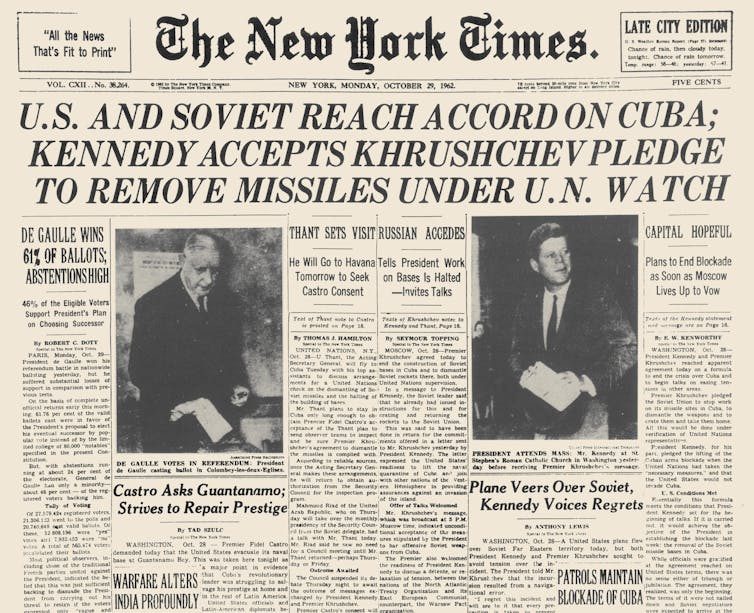
The United States and the Soviet Union came dangerously close to war in October 1962 during the Cuban missile crisis. Just ahead of its 60th anniversary, Russian president Vladimir Putin is issuing nuclear threats following the unexpectedly poor performance of his troops in Ukraine. The invasion poses a new kind of challenge to European security, but as in 1962, tensions between Russia and the west are rising.
Talking of use of nuclear weapons, the US defence secretary Lloyd Austin recently said that Putin could make “another decision”. US teams have been exploring possible responses to a nuclear attack, it has emerged.
Journalists ask: “How close we are to nuclear war?.” It’s hard to tell. Deliberate escalation may be unlikely, and we may avoid the worst-case scenario. However, there are many situations that could unintentionally lead to disaster.
The Cuban missile crisis cannot teach us how to avert war – it shows us that, once tensions are ratcheted up, this comes down to luck. Instead, we should learn from the crisis, the nearest the world has got to nuclear war, that the very existence of nuclear weapons always invites catastrophe.
We have been lucky to avoid nuclear war so far. If the nuclear crisis in Ukraine is averted, we will have been lucky again. The key lesson of Cuba is don’t mistake luck in Ukraine for reassurance that nuclear war in the 21st century is impossible.
Learning from history
On October 14, 1962, a US spy plane captured photographs of Soviet missile launch sites under construction in Cuba. Missiles launched from Cuba would be within range of much of the US mainland. In response, US president John F. Kennedy imposed a naval blockade of Cuba.
This was intended to prevent Soviet nuclear weapons reaching the Caribbean island. Kennedy demanded that Soviet premier Nikita Khrushchev remove the weapons. Khrushchev refused.
Over the days that followed, the two leaders traded private appeals and public demands, urging each other to back down. On October 26, Cuban prime minister Fidel Castro wrote to Khrushchev, asking him to attack the US. On October 27, Soviet antiaircraft missiles shot down a US spy plane over Cuba.
Realising that war was imminent, Kennedy and Khrushchev offered concessions. Kennedy agreed to remove US intermediate range nuclear missiles from Turkey - within range of the Soviet Union. In return, Khrushchev agreed to remove the offending Soviet missiles if the US promised not to invade Cuba afterwards. By October 28, the crisis was over. Global thermonuclear war was avoided - but only narrowly.
Creating an illusion of safety
Despite the close call, many analysts were over optimistic about lessons from the crisis. Influential US political scientist Joseph Nye argued that the crisis produced a sense of vulnerability and fear among policymakers and strategists. US and Soviet leaders learned from this experience (and other near misses) that they had been lucky to avoid war, and that measures were needed to prevent future crises. In response, they created arms control agreements and lines of communication, intended to make future crises less likely. These can be helpful, but they contribute to an illusion of safety.
President Kennedy’s speech on the Cuban missile crisis.
Alternatively, others including US historian John Lewis Gaddis have argued that the crisis showed that nuclear deterrence works: the Soviet Union was deterred from attacking by the prospect of a devastating nuclear response from the US. Under this argument, the crisis was under control, despite misunderstandings between the leaders. Kennedy and Khrushchev calculated that the other wanted to avoid conflict, and the prospect of nuclear retaliation lowered the risk that either would attack.
Alamy
These lessons have influenced how we interpret the nuclear dangers of the war in Ukraine. Most western officials act as if Russia’s nuclear threats are a bluff, because Putin is well aware of the devastating potential of nuclear escalation. Furthermore, conventional wisdom still tells us that possessing nuclear weapons – or being under the nuclear umbrella of an alliance such as Nato – is a reliable way of deterring Russian aggression.
Some would argue that these lessons come from a fallacious interpretation of the Cuban missile crisis: because we avoided nuclear war then, nuclear war in the future must be unlikely. On the contrary, over a long enough timeline, it is inevitable. Some people tell us that the continued existence of nuclear weapons isn’t really dangerous, because we’ve learned how to minimise the risk of war, and even that nuclear weapons themselves make war less probable. They encourage us to believe that we can control nuclear escalation and accurately calculate nuclear risks.
Recent research and reviews of Cuban missile crisis documents has shown that many global leaders believed that the nuclear risks were under control during the crisis. Nuclear history expert Benoît Pelopidas shows that, even at the height of tensions, French and Chinese leaders were less fearful of nuclear war than many might expect. For them, the fact that war was avoided simply proved that it is possible to reliably “manage” the danger of nuclear weapons.
In addition, most scholars now agree that nuclear war was only avoided during the crisis by sheer luck, not rational decision making. For example, on October 27, 1962, a Soviet submarine captain believed that war had begun. He decided to fire his nuclear torpedo at US ships, but was convinced otherwise by a fellow officer. On October 28 1962, US forces in Okinawa, Japan, received a mistaken order to launch 32 nuclear missiles, again only being stopped by one quick thinking captain.
Remember that Putin could invade Ukraine without worrying about a western military response because of Russia’s ability to threaten nuclear retaliation. He may yet calculate that he can use tactical nuclear weapons to defend against a Ukrainian counter-attack without provoking a Nato nuclear retaliation, because western leaders will not risk nuclear war. He may be mistaken.
Comforting stories about the cold war have encouraged people to believe that nuclear deterrence keeps the peace. This is not true. We have forgotten the dangers of states holding large nuclear arsenals. Assuming nuclear war in Ukraine is avoided, the lesson from Cuba? Don’t forget again.
"avoid it" - Google News
October 04, 2022 at 06:57PM
https://ift.tt/rNCGjFU
Nuclear war: does it take luck or reasoning to avoid it? Lessons from the Cuban missile crisis, 60 years on - The Conversation Indonesia
"avoid it" - Google News
https://ift.tt/OPjD0o6
https://ift.tt/kUDHzfn
Some of the most elite runners from around the world — and about 40,000 other committed participants — are here to run 26.2 miles Sunday when the Chicago Marathon marks its 45th anniversary.
The race starts in waves beginning at 7:20 a.m. in Grant Park and follows a route through 29 neighborhoods. It is a flat, fast course considered one of the world’s six major marathons.
Advertisement
But it didn’t start out that way. Heck, the first race wasn’t even 26.2 miles. Yet it has become more inclusive for a variety of people — including wheelchair racers — throughout the decades and has been canceled only twice: because of the lack of a sponsor in 1987 and the coronavirus pandemic in 2020.
Here’s what to know if you plan to participate, cheer on a runner or just want to avoid traffic jams on race day.
The start line is located in Grant Park at the intersection of Columbus Drive and Monroe Street.
7:20 a.m.: Men’s wheelchair
7:21 a.m.: Women’s wheelchair
7:23 a.m.: Handcycle
7:30 a.m.: Wave 1 (red)
8 a.m.: Wave 2 (blue)
8:35 a.m.: Wave 3 (orange)
9:30 a.m.: Spectator access to Grant Park begins
It’s early in the week, but Sunday’s race forecast looks good: a high temperature of 61 degrees with a few afternoon clouds and winds WSW at 10-15 mph. Check the latest forecast here.
What are the ideal race conditions? Temperatures between 40 and 50 degrees, low humidity, partly cloudy and dry.
The hottest
Amber Mercier, left, and Leslee Hewlett, both of Chicago, receive water as the runners head east on West Jackson Boulevard during the marathon on Oct. 7, 2007. The race was cut short because of heat-related stresses, and one person died during the event. ( José M. Osorio/Chicago Tribune)
The high was 89 degrees on Oct. 7, 2007. For the first time in Chicago Marathon history, officials cut the race short as hundreds of runners laboring across oven-like streets were treated for heat-related illnesses. The stoppage happened about 3½ hours after the start amid complaints of insufficient water for the nearly 36,000 runners.
Of the 35,867 who started, 24,933 finished. More than 300 runners were taken from the course in ambulances. One runner, a Michigan police officer with a heart condition, died, although the Cook County medical examiner’s office determined his death was not heat-related.
The coldest
The low temperature for the Oct. 30, 1988, race was 21 degrees.
Advertisement
Chicago has one of the flattest — and hence fastest — marathons in the world. Five world records have been set here, but many runners compete in this race to qualify for others, such as the Boston Marathon.
Men’s record
2:03:45. Set in 2013 by Dennis Kimetto of Kenya
2:05:42. Set in 1999 by Khalid Khannouchi of Morocco
2:08:05. Set in 1984 by Steve Jones of Great Britain
Women’s record
2:14:04. Set in 2019 by Brigid Kosgei of Kenya
2:17:18. Set in 2002 by Paula Radcliffe of Great Britain
2:18:47. Set in 2001 by Catherine Ndereba of Kenya
Runners start and finish in Grant Park but go as far north as Sheridan Road and as far south as 35th Street. Streets along the course will be closed for most of the morning and reopen on a rolling basis. (Note: The route is subject to change.)
Time limit
The course is open for 6 hours, 30 minutes. Registrants must be capable of completing the full distance, start line to finish line, within this time requirement (about 15 minutes per mile). Participant times greater than the event time requirement will not be recognized as official.
Advertisement
Parking
No-parking zones along the course will be enforced beginning at 1 a.m. Sunday, which means any vehicles in those areas will be ticketed and towed.
Road closures
Roads on the course close at 7 a.m. and begin reopening at 9:30 a.m. after the final runners have passed through. In the Loop, plan for roads to reopen at 10 a.m. Lincoln Park roads are set to reopen around noon, Near West Side around 1:30 p.m., Pilsen around 3:15 p.m., Bronzeville around 4 p.m. and the entire course around 6 p.m. But as always, times are subject to change, so check first.
Grant Park
Roads inside Grant Park will close Thursday and most will reopen by Sunday evening. All streets will reopen by 6 a.m. Monday.
Advertisement
To avoid delays
Consider using Jean Baptiste Point DuSable Lake Shore Drive and the expressways — including the Dan Ryan (I-90/94), Kennedy (I-90/94), Eisenhower (I-290) and Stevenson (I-55) — instead of local roads.
Parking
Runners and spectators can reserve a parking spot in advance through Millennium Garages, ParkWhiz or SpotHero. There will be no parking along the course.
Chicago Transit Authority trains and buses
The CTA will add service on its Red, Blue, Brown and Green lines and earlier service on the Purple Line on Sunday. Some buses will be rerouted. See the CTA website for more information, including where to purchase passes in advance, race viewing areas near CTA stations and park-and-ride locations.
Advertisement
Metra
Metra will run extra trains in addition to its regularly scheduled Sunday train service on the Metra Electric, Milwaukee District North and Union Pacific Northwest and West lines. Unlimited rides Sunday are available for $7. See the Metra website for more information.
South Shore Line
The South Shore Line, which connects South Bend, Ind., with Chicago, will operate extra service on race day. See the South Shore Line website for more information.
Image 1 of 53
The first runners cross the Outer Drive Bridge shortly after the start of the Mayor Daley Marathon on Sept. 25, 1977. (Karen Engstrom / Chicago Tribune)
Starting line
To avoid extra crowds, spectators aren’t allowed to escort runners to the start line or greet runners at the finish line. Organizers recommend spectators support runners from various spots on the course and meet up with runners after the race in designated areas within Grant Park.
Advertisement
Finish line
The closest spot to view runners at the finish line is the Bank of America Cheer Zone at Mile 26, Michigan Avenue and Roosevelt Road.
Reunite with a runner
The 27th Mile Post-Race Party and Runner Reunite area of Grant Park will open to spectators at 9:30 a.m. To access this area, spectators must pass through security and bag screening at Jackson Drive and Michigan Avenue or Ida B. Wells Drive and Michigan Avenue.
Race participants will meet at the start line in Grant Park.
Packet pickup
Advertisement
Must be claimed by each participant at the Health & Fitness Expo at McCormick Place, Lakeside Center on Friday or Saturday. Bring photo identification to obtain a bib number, timing device, gear-check tag, participant shirt and bag. No one will be allowed to pick up these items on behalf of others. Items will not be available for pickup on race day.
As in years past, only participants displaying their race bibs, event staff with proper credentials and ticketed guests will have access to the start and finish areas in Grant Park. Marathon participants are asked to use the transparent bags they receive from the pre-race expo to expedite the security screening process. Runners are required to register with a government-issued photo ID. The event website has information on the event alert system.
Sources: Bank of America Chicago Marathon, Tribune reporting and archives
"avoid it" - Google News
October 04, 2022 at 05:30PM
https://ift.tt/faRXsnw
Chicago Marathon 2022: Route, tips for spectators and participants — and how to drive downtown (or avoid it) on race day - Chicago Tribune
"avoid it" - Google News
https://ift.tt/OPjD0o6
https://ift.tt/kUDHzfn
Overland Park city council is set to vote Monday night on the use of $5 million in chip seal as part of the its annual street maintenance program.
Driving the news: The Overland Park Public Works Committee on Wednesday voted to recommend approval of the city’s 2023 annual maintenance programs for street, stormwater and traffic repairs.
The maintenance programs include contracted major repairs, preservation, rehabilitation or replacement of stormwater, street and traffic infrastructure.
The city approved the program’s budget as part of a 50-year financial plan for capital improvements and maintenance programs.
With the programs, the goal is to keep infrastructure in “good” condition, extend useful life and stay ahead of failures, according to city documents.
Street maintenance program: The committee approved a roughly $21.5 million total budget for street maintenance, including about $5 million going towards chip seal for 166 lane miles.
Another $1.9 million is put aside for 6 lane miles’ worth of residential overlay, while $4.3 million will go toward 16 lane miles of thoroughfare overlay.
With the maintenance program, the city is also setting aside $1 million for its crack seal program, which is the process of placing an adhesive sealant into cracks on street surfaces. The process prevents moisture and road debris from getting inside the pavement, according to city documents.
A full list of the 2023 street maintenance repairs can be found here.
A draft map outlining which roads will receive repairs as part of the 2023 maintenance program. Roads outlined in red are expected to get chip seal treatment. Image via Overland Park city documents.
Other maintenance programs: In addition to street maintenance, the committee also approved $2.1 million for the stormwater maintenance program and $750,000 for the traffic maintenance program.
Major storm sewer repair work for 2023 is slated for the following areas:
West 97th and Cedar streets
Lowell Avenue and West 113th Terrace
Indian Creek Drive east of Lamar Avenue
8509 Robinson St.
Downstream bridge apron replacement on Gillette Street, north of West 119th Street
Pipe condition assessment at various sites
The $750,000 for traffic maintenance is slated toward traffic signal replacement at West 87th Street and Antioch Road, and streetlight replacement of street lights near West 91st and Bond streets.
What’s next for Overland Park’s 2023 annual maintenance programs?
Now that the 2023 maintenance programs received approval from the committee, it must now come before the Overland Park City Council for final approval.
The items will be up for discussion and voted upon at the Oct. 3 council meeting.
"seal" - Google News
October 03, 2022 at 11:30PM
https://ift.tt/8ShV4ZP
Overland Park looks to approve $5M in upcoming chip seal work - Shawnee Mission Post
"seal" - Google News
https://ift.tt/ty1MzWR
https://ift.tt/kUDHzfn